
(Sorry to the listeners, the audio wouldn’t upload. Will try again later)
Last week was a big one. December is always one of those months where everything takes off. People know that the world is about to shut down for a few weeks, so everyone is trying to get ahead of the shutdown. For me, that means a lot of client requests as runners are eager to maximise their time off work and hit the new year with full fitness and plan to move toward their next event. Then, you throw in school break up, work parties and life, and December goes hard!
For this week's edition, I want to throwback to a topic I introduced at the beginning of my Ultrarunner to Track Beast journey - The Power Duration Curve, which helps explain the metabolic and muscular dynamics during high-intensity efforts and what this means for my 5km run time (and maybe yours).
I’ll use my weekday track session as an example.
Session Analysis: The Interplay of Metabolic Processes and Muscle Contractility
The Training Session: I tackled 5x 400m intervals with 1-minute rest, each 400m in 1:09, followed by 2x 800m intervals with 1-minute rest, aiming to maintain the same pace.
The Challenge: Despite my best efforts, my pace dropped in the last 400m of the final 800m interval, clocking in at 1:18.
Understanding W' Depletion and Muscle Contractility
Initial 400m Intervals: These intense efforts were at 120% of threshold power, tapping significantly into my W' (“W prime” or “anaerobic work capacity”), the finite amount of energy available above my threshold.
Depletion Over Time: With each 400m interval and the insufficient 1-minute recovery, my W' was progressively depleted. This isn't just about energy stores but involves complex metabolic and physiological processes.
Metabolic and Muscular Dynamics
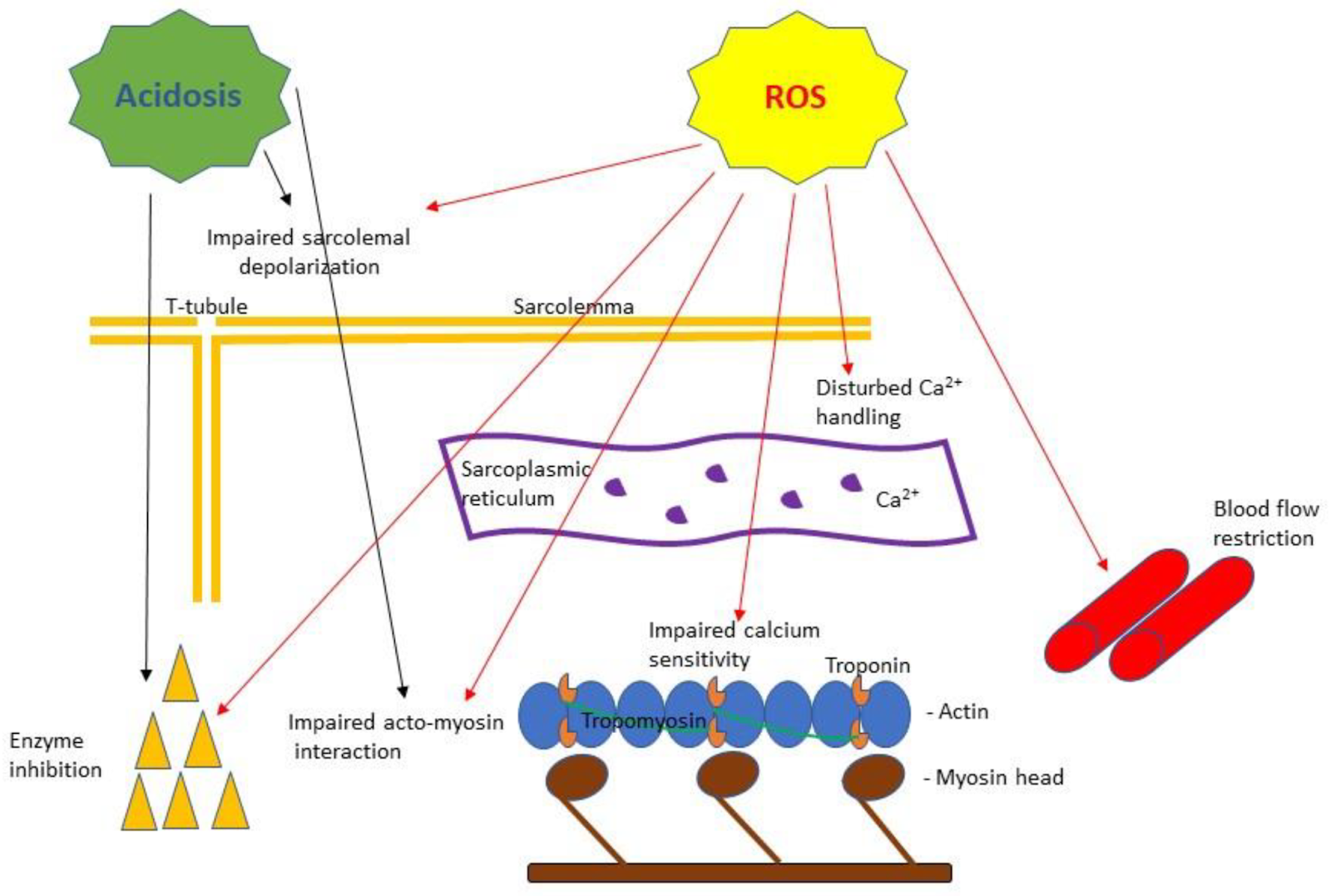
Accumulation of Metabolic Byproducts: High-intensity efforts lead to an accumulation of hydrogen ions and inorganic phosphate, decreasing muscle pH (acidosis).
Impact on Muscle Contractility:
Reduced Enzyme Efficiency: Acidosis inhibits critical enzymes in the glycolytic (glucose) pathway, reducing muscle fibre efficiency.
Impaired Calcium Handling: The acidic environment affects calcium ion release and reuptake in muscle cells, crucial for muscle contraction.
Altered Myofilament Sensitivity: Sensitivity of muscle contractile proteins to calcium is reduced, leading to decreased force of contraction.
Implications for the 800m Intervals and 5km Run Time
Cumulative Effect: When I started the 800m intervals, my muscles were already compromised in contractile capacity due to the accumulated metabolic byproducts.
The Final Slowdown: This explains the inability to maintain the desired pace in the last 400m of the final 800m. My muscles couldn't contract as efficiently or powerfully due to reduced pH and impaired calcium handling.
Predicting 5km Performance: This session indicates that my current W' and muscle contractility might not support the sustained high-intensity effort required for a sub-15-minute 5km. The slowdown in the final stages of the workout suggests a need to enhance my anaerobic capacity and muscular endurance.
Conclusion: A Holistic Approach to Training
To improve my 5km time, I need to focus on training that enhances my anaerobic capacity, threshold power, and muscle contractility under acidic conditions. How am I doing this?
Initially, I had planned for this week’s track session to be 10x 400m + 1km, with the theory that the 1km would give me the best insight into what was left in my tank (W’). From there, I would have a solid idea about my capacity at the race in 10 days. However, dropping so quickly on the 800s at this recent track session, I know I need to up my prolonged exposure to a compromised metabolic environment, and the 400s don’t appear to be long enough to elicit the stimulus I’m after. I’ve decided I’ll do 5x 800m on 1min rest instead. The 800s will give me a more accurate insight into my 5km capacity by significantly reducing my ability to replenish my W’, so I’ve better understood what pace will cause a decline in force output. To get an accurate representation of my performance capacity, I’ll need to start a little slower so I don’t risk depleting my W’ too quickly and blowing up after three reps. If that happens, I won’t get good data. All I’ll know is that whatever pace I was running was way too fast 🤷🏼.
I’ll also try to get over to a 3000m race on Saturday, providing much of the same info and stimulus as the 5x 800m session but with even more race specificity. That will be family-dependent since it’s my son’s 4th birthday party in the morning!
Week Twenty-Six - Strava Link
📊11:47 hrs total (TSS 558)
🏃4x Run = 6:00 hrs (75 km)
🏊0x Swim = best intentions but too tired 🥱
🚵1x MTB = 1:30 hr (21 km)
🥾1x Hike = 5hrs
Mon - Rest Day
Tue - Easy Run w/ Emma (90 min)
Wed - 30min WU | Track Session 5x 400m, 2x 800m | 30min CD
Thur - Aerobic Trail Hills (90min)
Fri - MTBw/ @MTB_PhD (90min)
Sat - Threshold Session 1:35 hr (23 km)
Sun - Family Hike (5hrs)
Recent Content
I haven’t put out any content since last week's video and podcast, but you can read up on the power duration curve here or listen to the podcast linked earlier in the blog.
https://drwilloconnor.com/leveraging-the-power-duration-curve-to-evolve-from-an-ultramarathoner-to-a-track-beast/